Safe Water from the Mountain: Eastern Highlands, Papua New Guinea
How a community-built gravity pipeline reached more than 3,500 people, why we chose filters at the tap stands to make its water safe, and how a new local nonprofit, PNG Safe Water, will own and run the systems.
Clean Water Help is a 100% volunteer-run 501(c)(3) nonprofit (EIN 99-0765687). Founders cover all operating costs, so 100% of public donations go to projects. Numbers are current as of September 28, 2026. Photos are shared by partners with permission; names of private individuals are withheld. impact@cleanwaterhelp.org
At a glance
1 Executive summary
In 2024, Philip Wayaki Bongi and his community built a gravity water system: a catchment on a mountain creek, a storage tank, and a pipeline to tap stands in the village. Villagers dug the trenches by hand. An extension completed in 2025, funded through writer Elan Head’s appeal, brought the total to more than 3,500 people.
To add a dependable germ barrier at the taps that needs no power or daily trips uphill, the team looked at multi-barrier filtration. In June 2026, CWH’s technical team compared the options and chose ultrafiltration at each tap stand for a pilot. The pilot unit was delivered in September 2026, and a plumber is being arranged to install it.
At the same time, CWH is paying the start-up costs of PNG Safe Water, a nonprofit led by Philip with a PNG-majority board. CWH will manage the water projects until PNG Safe Water is operating, funded and self-governing, then step back to an advisory role.
What happens next
- Install the pilot at a tap stand, measure pressure, fit the pressure-reducing valve, and record cloudiness, bacteria and cleaning needs through the rainy season.
- If the pilot works, install four more systems, one for each community down the mountain.
- If sediment clogging makes filters impractical, train households in point-of-collection chlorination as the fallback.
- Register PNG Safe Water (Notice of Intent, 60-day public notice, incorporation; target January 2027), then open its bank account and tax registration.
- Raise about $25,000 (estimate): filtration for the existing line (about $5,000), a pipeline extension for about 1,500 more people (about $5,000) and a new pipeline for about 3,500 more people (about $15,000).
Key numbers and how solid they are
Each number is labeled by its basis: Measured counted or tested, Reported reported by a partner or a document, Record from our own payments, contracts and correspondence, Estimate a calculation or assumption, Planned a plan or target, not yet done.
| Item | Value | Basis | Source |
|---|---|---|---|
| People served by the pipeline | 3,500+ | Reported | Phase 2 completion report, 2025 |
| Original build cost | about $15,000 | Reported | Project summary, 2026 |
| Household repair-fund contribution | about K20 (about $4) | Reported | Phase 2 completion report |
| Parts per tap-stand filter unit | about $100–120 | Record | Supplier quote and invoice, Jul–Aug 2026 |
| Systems if the pilot works | 4 more | Planned | CWH plan |
| Filtration for the existing line | about $5,000 | Estimate | CWH plan |
| Pipeline extension | ~1,500 more people, about $5,000 | Estimate | CWH plan |
| New pipeline | ~3,500 more people incl. a mountain school, about $15,000 | Estimate | CWH plan |
| Full plan | about $25,000 for ~8,500 people | Estimate | 10-year life, about $0.30 per person per year |
| Estimated cost per life saved | about $450 | Estimate | Method at cleanwaterhelp.org/technical |
| PNG Safe Water registration | about K2,000–4,000 | Estimate | Start-up cost plan |
2 Background and progress
The place and the need
The project is in the Korepa area of Daulo District, near Goroka in Papua New Guinea’s Eastern Highlands. Before the pipeline, families walked miles each day for water that was not safe to drink, and relatives died of typhoid. A piped supply built in the 1980s had long since rusted out.
How the pipeline was built
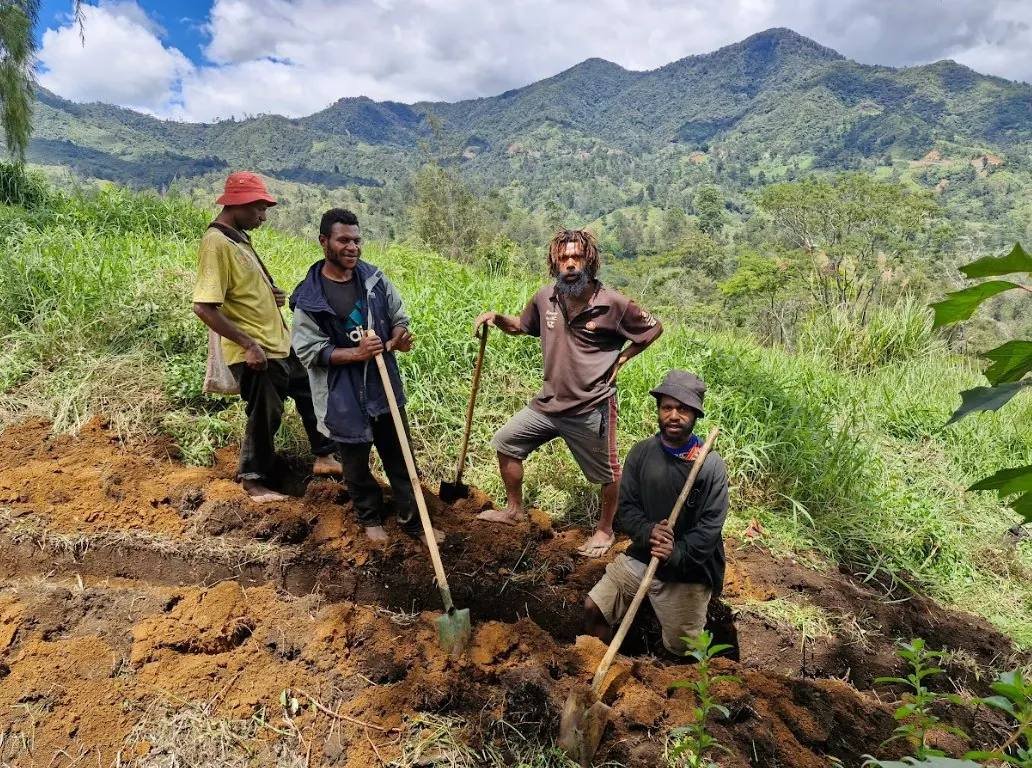
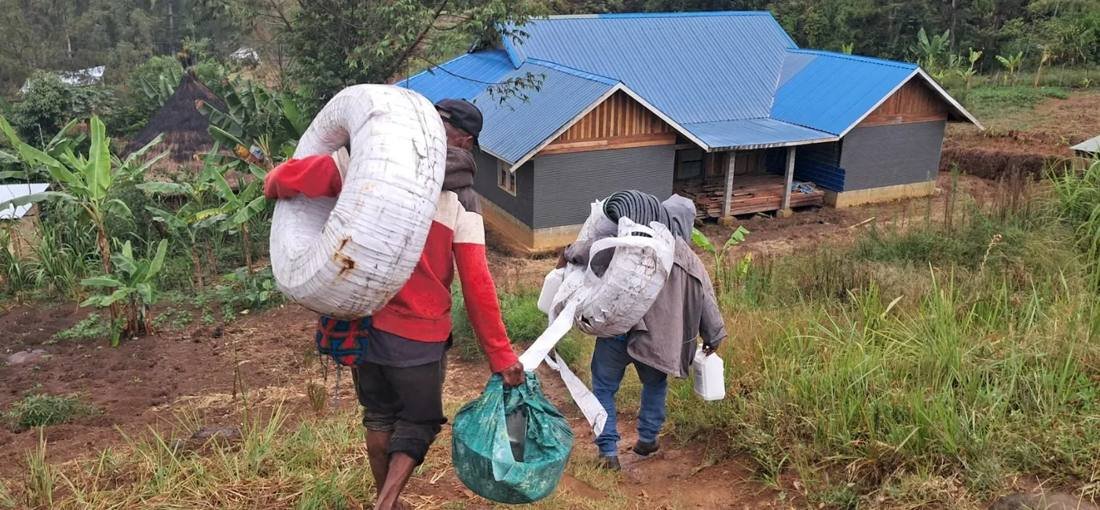
Philip Wayaki Bongi grew up in the area. Donors paid for his university education, and he built a career in monitoring and evaluation before turning to his village’s water. In 2024, with support from a US water charity, the community built a creek catchment, a storage tank and a gravity line with tap stands, for about $15,000 and in under six months. In 2025 an extension added about 1.5 km of pipe, a tank and eight tap stands, funded through an appeal by writer Elan Head. Carey Lafferty, Elan’s mother, knew Philip from her years with a health charity in PNG.
The community reports shorter walks, easier access for elderly people, and fewer cases of typhoid. These are community observations, not a health study.
How Clean Water Help became involved
A CWH volunteer contacted Philip in January 2026, and he joined our team in February. In May, about 45 CWH volunteers were invited to join technical, awareness and grant teams. The technical team met from June 2026 to work through distribution, safe water and long-term operation.
Timeline
- 1980sAn earlier piped supply is built; it later rusts out.
- Apr–May 2024Community gravity system started by Philip and the community.
- Dec 2024–May 2025Extension built; 3,500+ people served.
- Jan 20, 2026CWH volunteer contacts Philip.
- Feb 8, 2026Philip joins Clean Water Help.
- May 12–20, 2026CWH PNG teams formed (technical, awareness, grants).
- Jun 8–13, 2026Treatment options reviewed; ultrafiltration at the tap chosen for the pilot.
- Jul 2026Plan for an independent, locally led PNG nonprofit; CWH board funds the pilot.
- Aug 2026Pilot unit shipped from Hong Kong to Goroka.
- Sep 3, 2026PNG Safe Water’s first board meeting.
- Sep 2026Pilot unit delivered; a plumber is being arranged to install it.
- NextInstall and test; register PNG Safe Water (target January 2027).
3 Technical foundation
The tap-stand filter
Each unit fits at a tap stand and runs on the pressure the mountain provides. The treatment train is:
- Pressure-reducing valve (the lowest taps can see very high static pressure)
- 40 micron stainless steel spin-down screen with a flush valve
- 5 micron polypropylene cartridge
- PVDF hollow-fiber ultrafiltration membrane, about 0.01 micron, about 2,000 L per hour, backwashable
- Pressure gauges before and after each stage, so a caretaker can see when cleaning is due
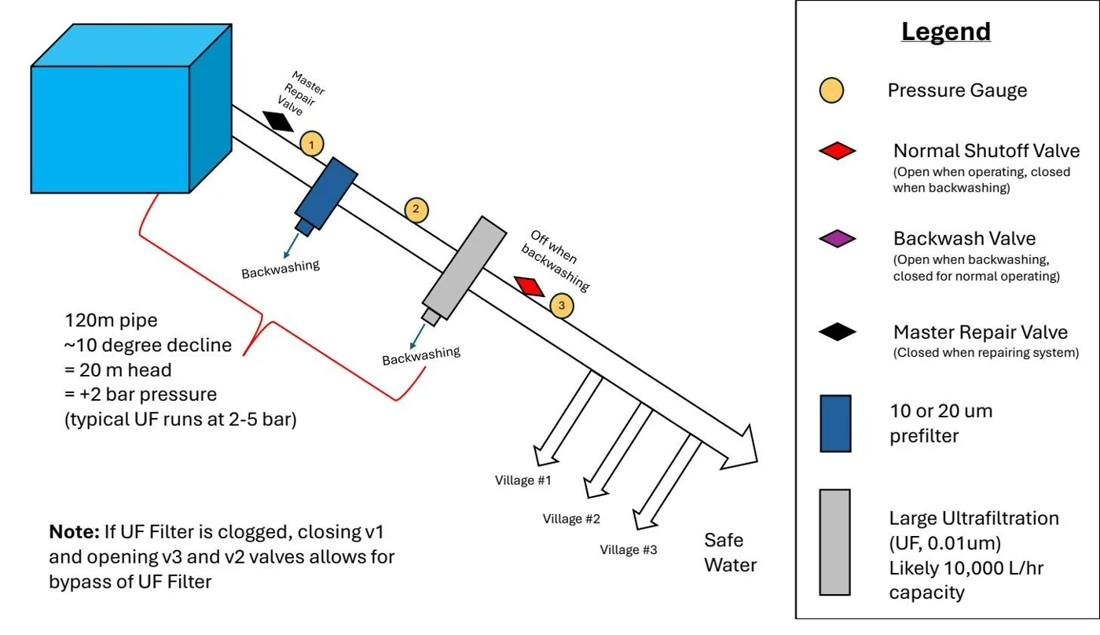
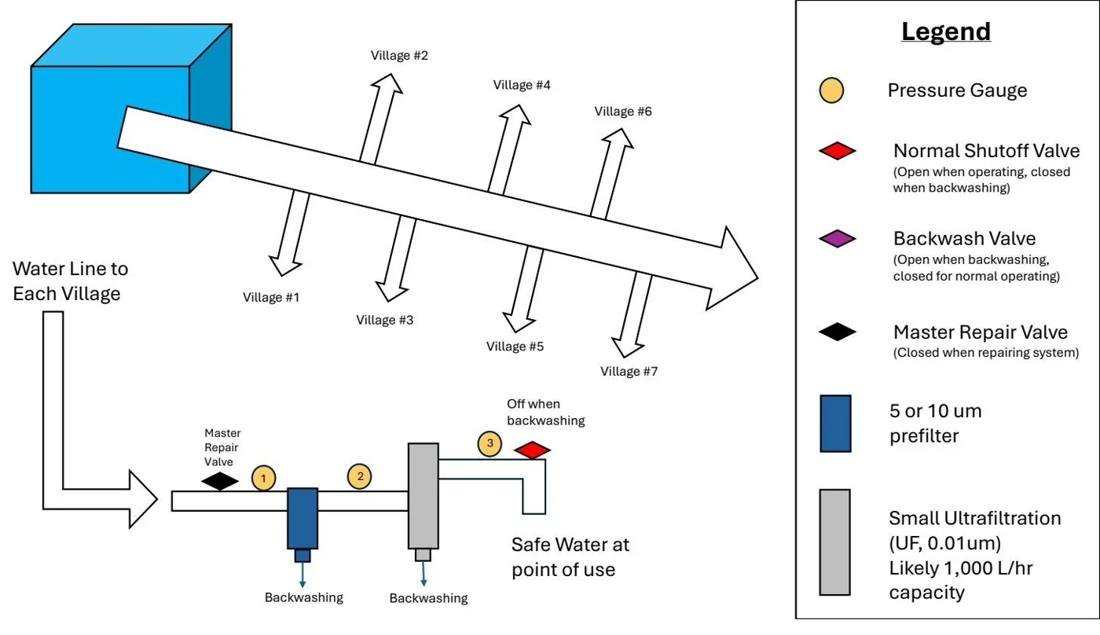
What it removes. Bacteria (0.5–2 micron, including those behind cholera and typhoid) and protozoa such as Giardia and Cryptosporidium (4–6 micron). What it does not do. It leaves no chlorine residual, so water can be re-contaminated in dirty containers after collection; hygiene training covers this.
Maintenance
A caretaker reads the gauges weekly, flushes the screen, and changes the 5 micron cartridge when the pressure drop rises. The membrane is backwashed as needed and replaced every one to three years (replacement elements cost about $15–30). Cloudy water from a tap is treated as a possible membrane breach: stop use and check.
Decisions and the options we set aside
| Decision | Options considered | Why |
|---|---|---|
| Ultrafiltration at each tap stand | One central unit at the tank; household filters | No power or chemicals; fault isolation; each village maintains its own unit. |
| No in-line chlorine dosing | Venturi or tablet dosers in the pipeline | Not proven at this flow; venturi dosers need more flow than the line provides; tablet supply is hard to sustain. |
| No UV | Solar-powered UV at the tank or taps | Needs electricity (no grid; theft risk for solar) and the same fine prefilter as ultrafiltration. |
| Point-of-collection chlorination as fallback | No fallback | Less ideal (daily effort; long-term use about 40–50%) but far better than nothing. |
| A new, locally led nonprofit | A CWH branch in PNG | Local ownership; grants held in PNG Safe Water’s own name; CWH steps back once it is self-governing. |
Risks and how we respond
| Risk | Level | Response |
|---|---|---|
| Sediment clogging after heavy rain | High | Screen and cartridge prefilters, source protection, gauges; fallback to chlorination. |
| Landslides and pipe damage | Medium | Community repair fund; local plumber; spare pipe. |
| Theft or tampering | Medium | Lockable enclosures; no solar panels at remote sites. |
| Reliance on one caretaker per system | Medium | Train at least two people per village. |
| Registration delays | Low | Filing prepared; 60-day public notice built into the plan. |
4 What we learned and what is still open
- Respect what the community already built. The pipeline is the hard part and it works. Our job is to add what is missing, not start over.
- Design for the site, not the catalog. No power, steep slopes, landslides and long supply lines ruled out several standard solutions.
- Plan the handover from day one. PNG Safe Water gives the community ownership and a legal home for future grants.
Open questions
- How often do the prefilters and membranes need cleaning in the rainy season?
- What pressures do the lowest tap stands see, and which valve setting protects the units best?
- Can the creek source be protected further upstream to reduce sediment?
- Which funders will support the pipeline extension and the new pipeline?
5 How you can help
Help bring safe water to more villages
Your gift pays for filtration on the existing line, pipe to about 5,000 more people and PNG Safe Water’s start-up costs. The water plan costs about $25,000 (estimate). 100% goes to the project.
- Give: cleanwaterhelp.org/projects/png
- Engineers and water scientists: join the PNG technical team
References and sources
- Community Water Supply Project, Phase 2 Completion Report and Phase 2 update, 2025 (Philip Wayaki Bongi).
- Clean Water Help. PNG UF System Concept: installation and operation protocol (2026).
- Clean Water Help PNG technical team: Distribution; Safe Water; Legacy and Longevity working documents (June 2026).
- Clean Water Help. Master Project Information, Parts 3.3 and 5A (internal, September 2026).
- Papua New Guinea Associations Incorporation Act 2023.