Drinking Water After Typhoons and Earthquakes: The Philippines Drinking Water Explorer
A free, open-source prototype app that estimates which water refilling stations are likely to stop working after a disaster and which nearby stations can keep supplying responders. This report explains the problem, how the app works, its limits and the plan to test it.
Clean Water Help is a 100% volunteer-run 501(c)(3) nonprofit (EIN 99-0765687). Founders cover all operating costs, so 100% of public donations go to projects. Numbers are current as of September 28, 2026. Photos are shared by partners with permission; names of private individuals are withheld. impact@cleanwaterhelp.org
At a glance
1 Executive summary
The project began in March 2026 as an anticipatory-action tool with the Global Centre on Disaster Risk and Poverty, anticipating a wide range of disaster needs before storms land. In July 2026 we narrowed it to one question: where treated drinking water is likely to run out, estimated from how refilling stations lose power, utility water or their buildings, and where the nearest working supply is.
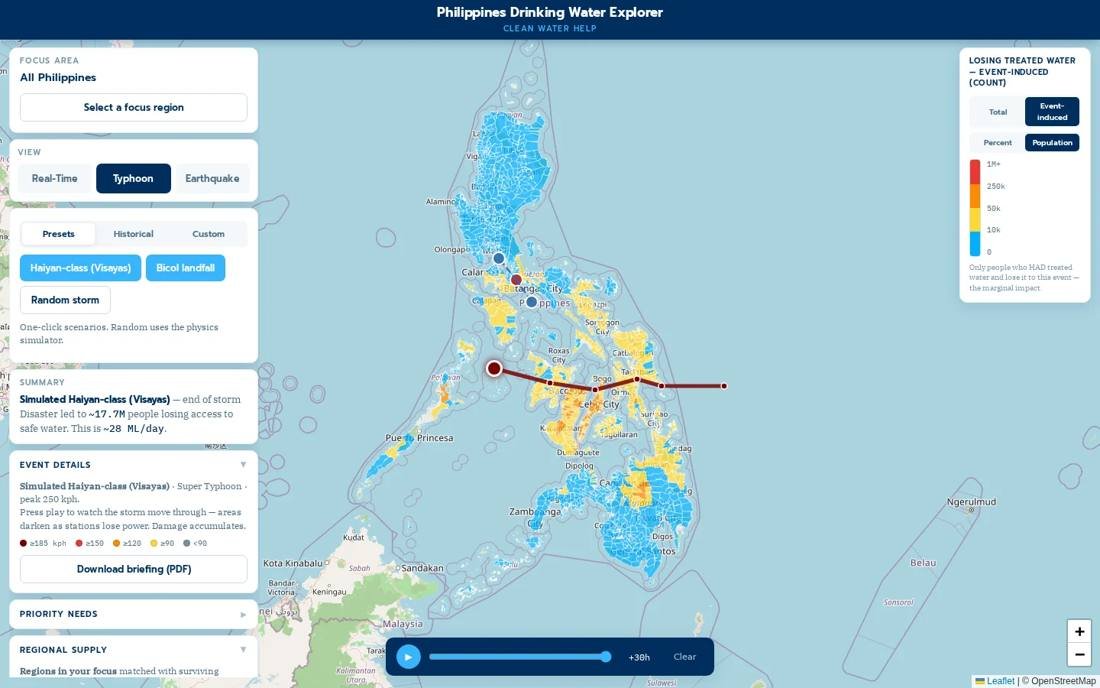
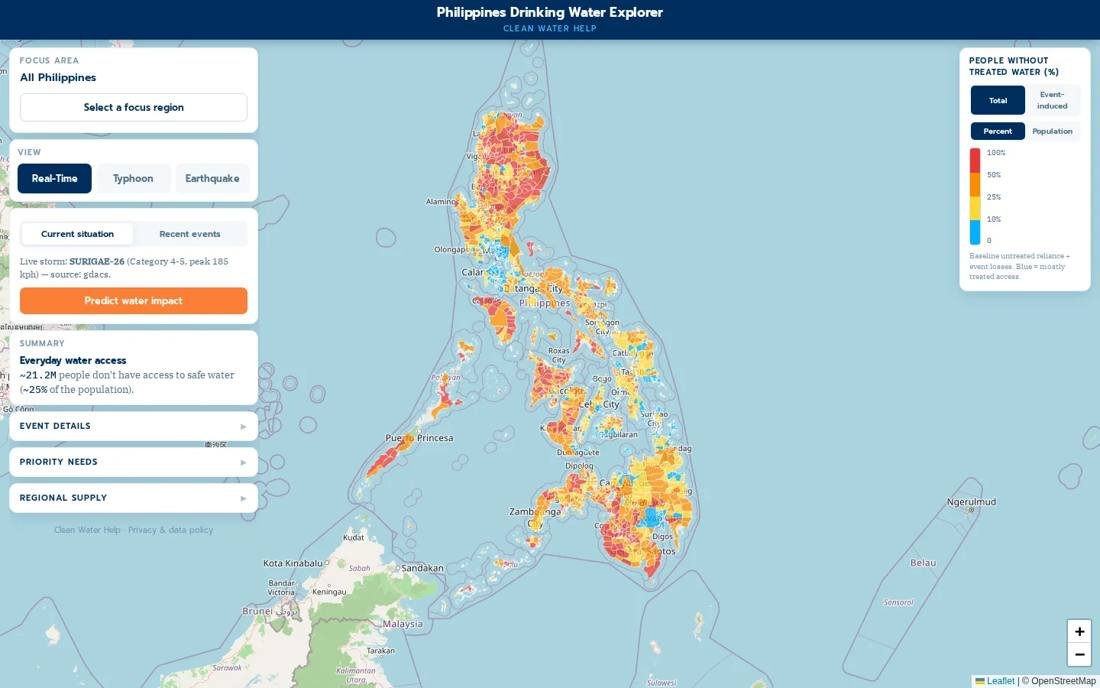
The prototype is online at philippines-typhoon-draft.web.app. It follows live storms, replays 539 historical typhoons and major earthquakes, estimates how many people lose treated water, and matches those areas with nearby supply. It is free and open source.
The plan for late 2026 is to interview station owners and local disaster offices, run a tabletop exercise, and name a Filipino co-lead, then run a pilot with one local government in 2027.
What happens next
- Name a Filipino co-lead and a storm-duty volunteer.
- Interview about 10 refilling-station owners and disaster risk reduction offices about what happened in recent storms.
- Run a tabletop exercise using a past storm.
- Fix reliability issues so the app stays up during heavy use.
- Agree a pilot with one local government for 2027.
Key numbers and how solid they are
Each number is labeled by its basis: Measured counted or tested, Reported reported by a partner or a document, Record from our own payments, contracts and correspondence, Estimate a calculation or assumption, Planned a plan or target, not yet done.
| Item | Value | Basis | Source |
|---|---|---|---|
| Households using refilling stations as main drinking source | 46.2% | Reported | PSA 2020 Census of Population and Housing |
| Historical typhoons available to replay | 539 | Record | App data (IBTrACS) |
| Supply-matching radius | 100–500 km | Record | App settings |
| Cost to users | Free, open source | Record | CWH decision, May 1, 2026 |
| Model calibration | Not yet done | Record | Path-forward review, Sep 23, 2026 |
2 Background and progress
Why refilling stations matter
Most Filipinos who buy drinking water get it from refilling stations: small, mostly family-run shops that treat tap or well water and sell it in 5-gallon jugs. After a typhoon or earthquake, stations fail for three main reasons: power loss, loss of the utility water they treat, and damage to the building. Treated water can disappear for days to weeks.
Relief water trucked from far away often arrives after the first days, when waterborne illness spreads fastest. Yet stations outside the damage zone are often still running and could produce more.
How the project evolved
The first version, built with the Global Centre on Disaster Risk and Poverty, mapped risks for water, food, shelter, power and health. In July 2026 a review found that other groups already forecast most of those needs. We refocused the app on drinking water, where CWH has expertise: estimating refilling-station outages and matching areas that lose treated water with nearby working supply.
Timeline
- Mar 7–17, 2026Anticipatory-action pitch and platform design.
- Mar 19, 2026Code repository started.
- Apr 2026First typhoon risk map online.
- May 1, 2026Decision: free and open source.
- May 17, 2026Prototype shared with University of the Philippines experts; one agrees to advise.
- Jun 8, 2026Philippines team meeting: partner with universities and responders.
- Jul 10–12, 2026Rebuilt around refilling stations.
- Sep 23, 2026Path-forward review: interviews, tabletop exercise, pilot.
- 2027Pilot with one local government.
3 Technical foundation
What the app does
- Hazard layer: live storm feeds, historical typhoon tracks, earthquake scenarios and custom scenarios.
- Station operability: estimates whether stations keep power, utility water input and their buildings.
- People affected: joins census and poverty data to estimate how many people lose treated water, shown as ranges.
- Supply matching: pairs each area losing water with areas likely still producing it within 100 to 500 km, labeled “candidate, verify by phone.”
- Briefing: one-page PDF for decision-makers.
Design principles
- Focus on drinking water, where CWH has expertise.
- Never show a problem without a possible solution.
- No false precision: ranges, not single numbers.
- Filipino-led and Filipino-fronted.
- Privacy first: no station contact data collected by design.
Decisions and the options we set aside
| Decision | Options considered | Why |
|---|---|---|
| Focus on drinking water only | Estimate all disaster needs | Other groups already forecast housing, food and cash needs; CWH’s expertise is drinking water. |
| Free and open source | Licensed product | Agencies can adopt and adapt it without cost. |
| Test with people before promoting | Launch publicly now | Uncalibrated estimates could mislead responders. |
Risks and how we respond
| Risk | Level | Response |
|---|---|---|
| Wrong estimates mislead responders | High | Label everything as estimates; tabletop testing; calibration with a partner. |
| No committed local owner | High | Name a Filipino co-lead; pilot with one local government. |
| App outage during storms | Medium | Reliability fixes and monitoring before storm season. |
| Privacy of station data | Medium | Collect no contact data without consent; follow the Data Privacy Act. |
4 What we learned and what is still open
- Narrow beats broad. The app became more useful when it focused on one question: where treated drinking water is likely to run out.
- Local partners first. A tool for Philippine responders has to be shaped and owned by them.
Open questions
- How long do stations actually stay down after typhoons and earthquakes, and why?
- How much extra water can a working station produce, and how quickly?
- Which local government is best placed for a 2027 pilot?
5 How you can help
Help us test it
We are looking for disaster offices, refilling-station owners, universities and humanitarian groups in the Philippines.
- Try it: philippines-typhoon-draft.web.app
- Contact: impact@cleanwaterhelp.org
References and sources
- Philippine Statistics Authority. Household Characteristics, 2020 Census of Population and Housing. psa.gov.ph
- Clean Water Help. Philippines Drinking Water Explorer (prototype). philippines-typhoon-draft.web.app
- Clean Water Help. Water Security Platform requirements (July 2026) and path-forward review (September 23, 2026).
- IBTrACS, International Best Track Archive for Climate Stewardship (historical typhoon tracks).