Scholarships for DR Congo Students (Goma, North Kivu)
How five students from eastern DR Congo (Goma) came to have full university scholarships, what each scholarship pays for, and how the program will extend to Papua New Guinea.
Clean Water Help is a 100% volunteer-run 501(c)(3) nonprofit (EIN 99-0765687). Founders cover all operating costs, so 100% of public donations go to projects. Numbers are current as of September 28, 2026. Photos are shared by partners with permission; names of private individuals are withheld. impact@cleanwaterhelp.org
At a glance
1 Executive summary
Clean Water Help started the program in 2026 to build local expertise in the places where we work. PALPER, our partner in Goma, collected 33 applications in June 2026. A panel of CWH volunteers ranked them, and scholarships were awarded in August.
In late August the national government suspended university activity in Goma and Bukavu for the 2026–27 year. We moved the program to ULPGL (Université Libre des Pays des Grands Lacs), a leading private university in Goma, whose fees are close to the award’s $500 tuition budget. On September 22, all five students had sponsors.
Papua New Guinea is next. Philip Wayaki Bongi, whose own university education was paid for by donors, is gathering applications from the Eastern Highlands for the December 2026 to January 2027 window.
What happens next
- Students complete their ULPGL applications with PALPER’s help; CWH makes the first payment once ULPGL accepts each student.
- Assign a CWH volunteer mentor to each student and set up PALPER internships.
- Collect first-semester results in January 2027 before the January payment.
- Open the PNG application window (December 2026 to January 2027) and raise $1,500 per PNG student per year.
- Recruit sponsors for later years so every student can finish a degree.
Key numbers and how solid they are
Each number is labeled by its basis: Measured counted or tested, Reported reported by a partner or a document, Record from our own payments, contracts and correspondence, Estimate a calculation or assumption, Planned a plan or target, not yet done.
| Item | Value | Basis | Source |
|---|---|---|---|
| Applications (Goma, June 2026) | 33 | Record | KoboToolbox and paper applications |
| Minimum state exam score | 70% | Record | Program rules |
| Students sponsored for 2026–27 | 5 | Record | CWH and ULPGL correspondence, Sep 21, 2026 |
| Award per student per year | $1,500 | Record | Scholarship agreement |
| ULPGL annual fees | $490–625 | Reported | ULPGL fee table, Sep 21, 2026 |
| Registration costs | $20 per student | Reported | ULPGL admissions instructions |
| PALPER management fee | $450 for 3 students + $150 each additional | Record | Grant agreement |
| PNG award (planned) | $1,500 per year | Planned | Same award as DR Congo |
| Support through graduation | $1,500 a year | Planned | Civil engineering 4 years; public health 3 years |
2 Background and progress
Why we fund scholarships
Water systems last when local people can run, repair and improve them. In Goma and the Eastern Highlands, capable students often cannot afford tuition, and many must work to support their families. A scholarship that pays only tuition often is not enough; the stipend lets the student study full time.
The idea came from our partners. Philip Wayaki Bongi, who leads our PNG work, attended university because donors paid his tuition when he had no money. That education led to his career in monitoring and evaluation and to the water project he started for his community.
How the program runs
PALPER recruits applicants, manages payments to students, hosts internships and tracks progress. CWH sets the rules, runs the review panel, raises the money and provides mentors. PALPER collected applications on KoboToolbox (in French) and on paper. The same form is ready in English for Papua New Guinea.
Selection
- At least 70% on the national state exam.
- A field that builds water or health expertise (civil engineering or public health at ULPGL).
- Scored by a panel of volunteer reviewers; rankings averaged.
- All candidates and PALPER checked against international sanctions lists.
- Sharing a student’s name, photo or story is optional and never a condition of the award.
The students
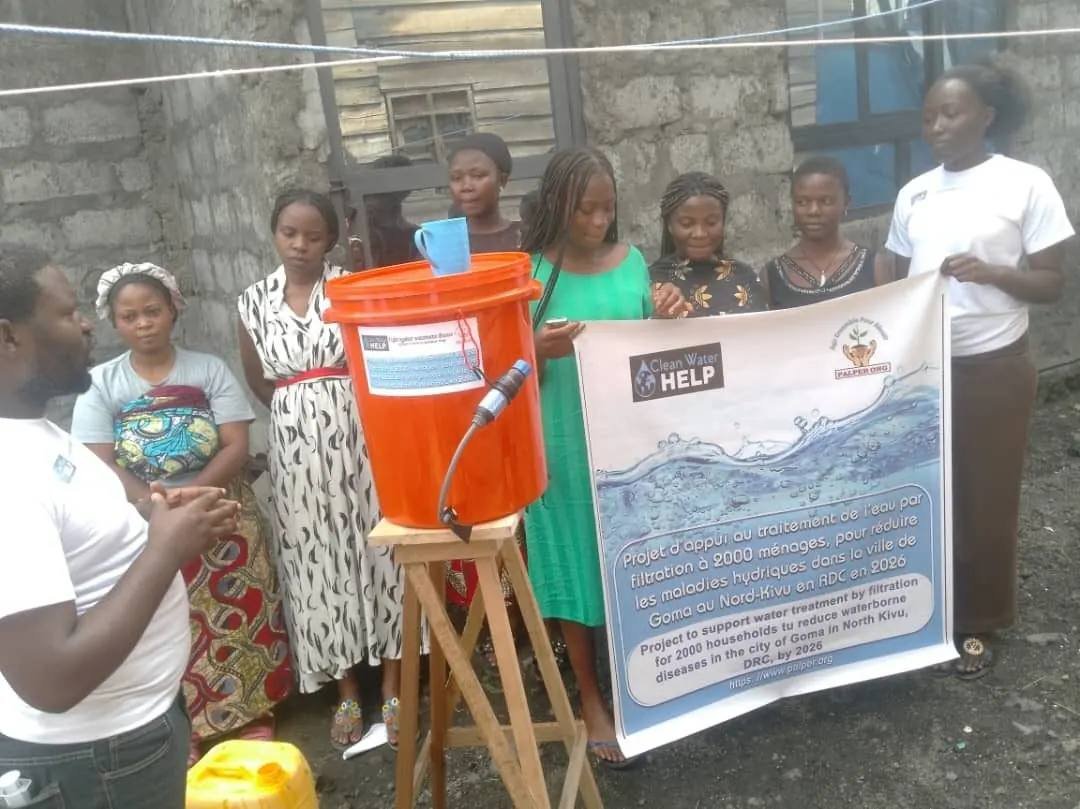
The five students are Lareine and Faustin in civil engineering, and Chantal, Ruphin and Bienvenu in public health. First names are shared with each student’s written permission.
Timeline
- Feb 25, 2026PNG scholarship idea proposed by Philip Wayaki Bongi.
- Apr 15, 2026Mentoring and scholarship program announced to volunteers.
- May 20, 2026Multilingual application form launched.
- Jun 8–15, 202633 applications from Goma collected with PALPER.
- Jun 19, 2026Award set at $1,500 per year after a cost analysis.
- Jul 6, 2026Applicants ranked by the volunteer panel.
- Jul 15–23, 2026Agreements and student guide drafted; sanctions screening completed.
- Aug 19, 2026Scholarships awarded.
- Aug 28–Sep 3, 2026Students and PALPER sign agreements.
- Late Aug 2026Universities in Goma and Bukavu suspended for 2026–27.
- Sep 21, 2026ULPGL admission terms received; CWH commits to fund the five students there.
- Sep 22, 2026All five students sponsored.
- Oct 15, 2026Classes start.
- Dec 2026–Jan 2027PNG applications.
3 Technical foundation
What the award pays for
| Item | Per year | Notes |
|---|---|---|
| Tuition and registration | about $500 | ULPGL fees are $490–625 depending on program and year; CWH covers any difference |
| Books and supplies | about $100 | |
| Living stipend | about $900 | About $100 a month for 9 months |
| Total | $1,500 | Paid through PALPER |
Payment schedule
- $600 once ULPGL accepts the student. CWH may pay the registration fee directly to ULPGL and give the student the rest.
- The remaining $900 of the year in later installments through PALPER.
- The January installment requires a passed first semester and regular contact with PALPER.
PALPER receives a management fee of $450 for the first three students plus $150 for each additional student, which covers its staff time for payments, tracking and reporting.
Safeguards
- Written agreements with each student and with PALPER (governing law: North Carolina).
- PALPER has adopted written policies on child protection, anti-fraud and corruption, data protection and conflicts of interest.
- Funds are released in installments against evidence, not in one lump sum.
- Student data stays private; only first names and approved photos are shared.
Decisions and the options we set aside
| Decision | Options considered | Why |
|---|---|---|
| Include a living stipend | Tuition only | Most students would otherwise work to support their families and could not study full time. |
| Move to ULPGL | Wait for the University of Goma to reopen; defer a year | The public university was suspended and degrees were at risk; ULPGL is established and its fees are close to the award’s tuition budget. |
| Pay through PALPER in installments | Pay universities or students directly | PALPER is on the ground, can verify registration and results, and handles transfers when banks are disrupted. |
| Fund one year at a time | Commit the full program up front | Keeps the program honest about funding; sponsors are recruited for later years. |
Risks and how we respond
| Risk | Level | Response |
|---|---|---|
| University closures or conflict | High | Private university with continuity; hold funds until ULPGL accepts the student. |
| Payment disruption | Medium | Installments through PALPER with receipts. |
| Student health or family emergencies | Medium | Awards can be held for a later start. |
| Sponsors for later years | Medium | Recruit multi-year sponsors; corporate sponsorship options. |
4 What we learned and what is still open
- The stipend is the scholarship. Tuition alone does not keep students in school when families depend on their income.
- Have a plan B. The university switch took less than a month because PALPER already had the relationships in Goma.
- Consent first. Asking students separately whether their story can be shared built trust and kept the program simple.
Open questions
- How can we fund each student through graduation (four years for civil engineering, three for public health)?
- Which PNG universities and fields fit best, and how will PNG payments work?
5 How you can help
Sponsor a student
$1,500 pays for a full year: tuition, books and a living stipend. Sponsors receive a progress update each semester. Companies can sponsor a named scholarship.
- Sponsor a student: cleanwaterhelp.org/donate
- Companies: impact@cleanwaterhelp.org
- Mentor a student: cleanwaterhelp.org/contact#volunteer
References and sources
- Clean Water Help. CWH–PALPER Grant Agreement, CWH Scholarship Agreement and Student Scholarship Guide (English and French), August 2026.
- ULPGL. Fee table and admission instructions for Civil Engineering and Public Health, September 21, 2026.
- SOS Médias Burundi. “DRC: Kinshasa closes universities in Goma and Bukavu,” August 29, 2026. sosmediasburundi.org
- Clean Water Help board approvals, July 20, 2026.