Gravity Filters for Families in DR Congo (Goma)
How a 10-filter pilot with our Congolese partner PALPER brought safe drinking water to about 250 people in Goma, what it cost, what we learned, and the plan to reach about 1,500 people by early 2027 and about 5,000 by the end of 2027.
Clean Water Help is a 100% volunteer-run 501(c)(3) nonprofit (EIN 99-0765687). Founders cover all operating costs, so 100% of public donations go to projects. Numbers are current as of September 28, 2026. Photos are shared by partners with permission; names of private individuals are withheld. impact@cleanwaterhelp.org
At a glance
1 Executive summary
PALPER, a Congolese NGO with more than 45 staff in North Kivu, asked Clean Water Help to partner in September 2025. Our volunteers chose a simple household technology (Sawyer gravity membrane filters), wrote the use and monitoring protocols in English and French, and paid for the filters and PALPER’s field costs. PALPER chose the households, installed the filters and trained each family. These filters target bacteria and protozoa. They are not a reliable barrier to viruses or dissolved chemicals. Safe storage and correct use remain important.
The pilot ran in two phases between June and August 2026 in five Goma neighborhoods. Each filter is shared by five households (about 25 people), so 10 filters reach about 250 people. Residents report fewer stomach illnesses and have asked for more filters and water containers. They call the filters chombo ya maajabu, Swahili for “instruments of wonder.”
In September 2026 the CWH board approved 50 more filters. The first 10 were paid for on September 21 and are in transit. When all 60 filters are in use, the program will reach about 1,500 people.
What happens next
- Receive and install filters 11 to 20, then pay for shipments 2 to 5 (10 filters each) as they arrive.
- Grow to about 200 filters, reaching about 5,000 people, by the end of 2027.
- Collect monitoring data for every filter: households served, backwash routine, and reported illness.
- After the filter rollout, buy a used truck, a pump and a collapsible tank so PALPER can deliver lake water to families.
- Write grants in PALPER’s name and recruit new funders and partners so the program can grow beyond Goma.
Key numbers and how solid they are
Each number is labeled by its basis: Measured counted or tested, Reported reported by a partner or a document, Record from our own payments, contracts and correspondence, Estimate a calculation or assumption, Planned a plan or target, not yet done.
| Item | Value | Basis | Source |
|---|---|---|---|
| Filters installed (pilot) | 10 | Reported | PALPER phase reports, Jul 16 and Aug 13, 2026 |
| Households served | 50 (5 per filter) | Reported | PALPER phase reports |
| People served | about 250 | Estimate | 50 households × ~5 people |
| Cost per filter, all-in | about $80 | Estimate | Filter, delivery, installation, training and materials |
| Cost per person | about $3.20 | Estimate | $80 ÷ 25 people, about 5 years of use |
| Estimated cost per life saved | about $1,000 | Estimate | Method at cleanwaterhelp.org/technical |
| Scale-up (50 filters) | about $4,000 | Estimate | 50 × $80, all-in |
| Filters 11–20 | paid, in transit | Record | Payment confirmation, Sep 21, 2026 |
| Reach with 60 filters | about 1,500 people | Planned | 60 × 25 people |
| Goal, end of 2027 | about 5,000 people | Planned | About 200 filters at 25 people each |
| Expected filter life | about 5 years | Estimate | With regular backwashing |
2 Background and progress
The need
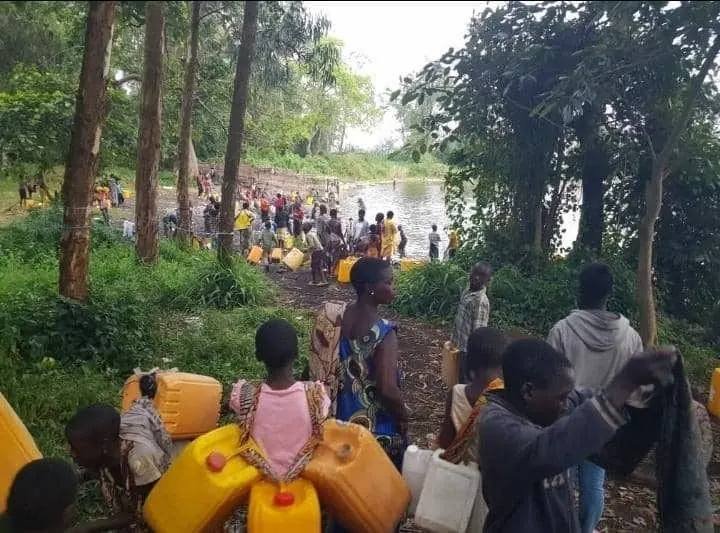
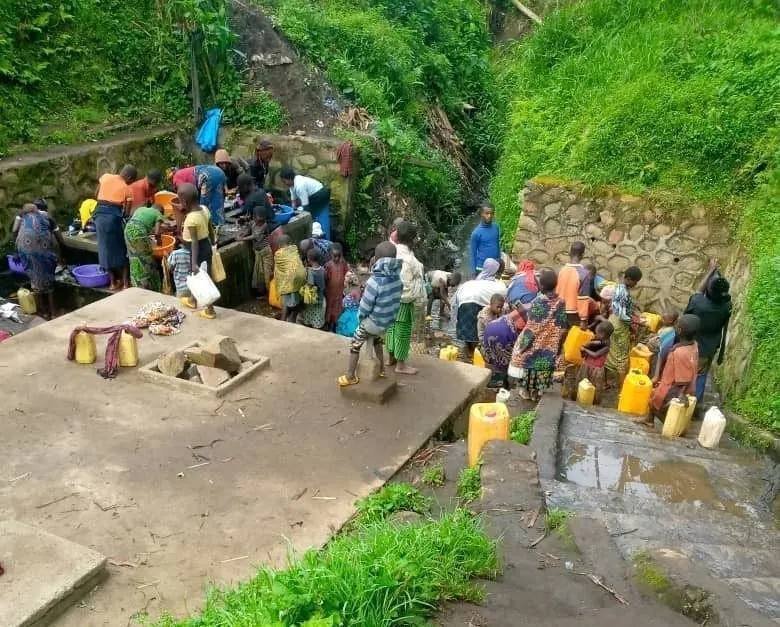
North Kivu has lived through years of armed conflict, displacement and disease outbreaks, including cholera and Ebola. Many families in Goma drink untreated water, often carried long distances. PALPER’s own 2025 assessment of the nearby Rwanguba health zone found only 11 of 174 water sources (6.3%) developed and working. Walking long distances to collect water also exposes women and children to violence.
Goma is built on volcanic rock, which makes wells impractical, and the neighborhoods we serve have no piped supply. That points to treating water at the household or neighborhood level.
The partner
PALPER asbl is a registered Congolese NGO working in education, health, water and sanitation, food security and protection across North Kivu and neighboring provinces. It has more than 45 full-time staff and works alongside international groups such as ACTED. PALPER leads the work on the ground and holds the relationships with families and local authorities. Clean Water Help supplies technical design, protocols, funding and grant writing.
What we did
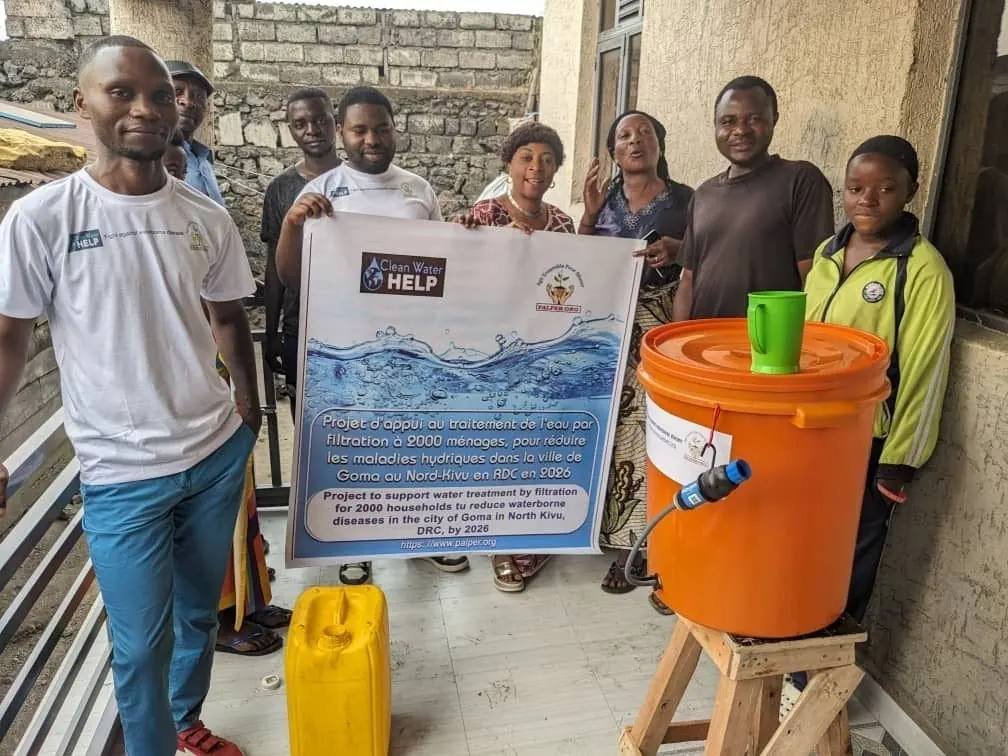
After an introductory call in September 2025, CWH volunteers formed funding, operations and technical teams in December. In early 2026 the team compared two low-cost options: gravity membrane filters bought in Kenya and hand-pump ultrafiltration units bought in China. Ten Sawyer gravity filters were ordered in April and reached Goma by truck on May 18, 2026. A filter-use procedure and a monitoring protocol were written in English and translated into French, and PALPER trained each household.
Installation ran in two phases. Phase 1 (reported July 16) placed 5 filters with 25 households; Phase 2 (reported August 13) placed 5 more with another 25 households. The five neighborhoods were Katoyi, Kasika, Kiziba, Mabanga and Kilijiwe in Goma’s Karisimbi commune.
Results so far
All 10 filters were in use when PALPER reported in August. Residents told PALPER that stomach illnesses eased, and a group of residents from Kasika sent a handwritten letter of thanks asking for more containers and, one day, piped water. These are community reports, not a health study; formal monitoring continues on PALPER’s paper forms.
Timeline
- Sep 3, 2025PALPER contacts Clean Water Help to propose a partnership.
- Sep 21, 2025First call between CWH and PALPER leadership.
- Oct 8, 2025DR Congo project page and GoFundMe launched.
- Dec 12–13, 2025Kickoff meeting; funding, operations and technical teams formed.
- Jan 2026Gravity filters from Kenya and hand-pump units from China compared.
- Apr 16, 202610 Sawyer filters ordered from the Kenya distributor.
- Apr 27, 20264 hand-pump units ordered from China for comparison (never delivered).
- May 18, 2026Filters arrive in Goma by truck.
- Jun 19–25, 2026Protocols finalized; kickoff and training with PALPER.
- Jul 16, 2026Phase 1 report: 5 filters, 25 households, 125 people.
- Aug 13, 2026Phase 2 report: 5 more filters; 50 households, about 250 people in total.
- Sep 1, 2026CWH board approves 50 more filters.
- Sep 21, 2026Filters 11–20 paid for and shipped.
- NextInstall filters 11–60; plan source-water delivery; grant applications.
3 Technical foundation
How the filter works
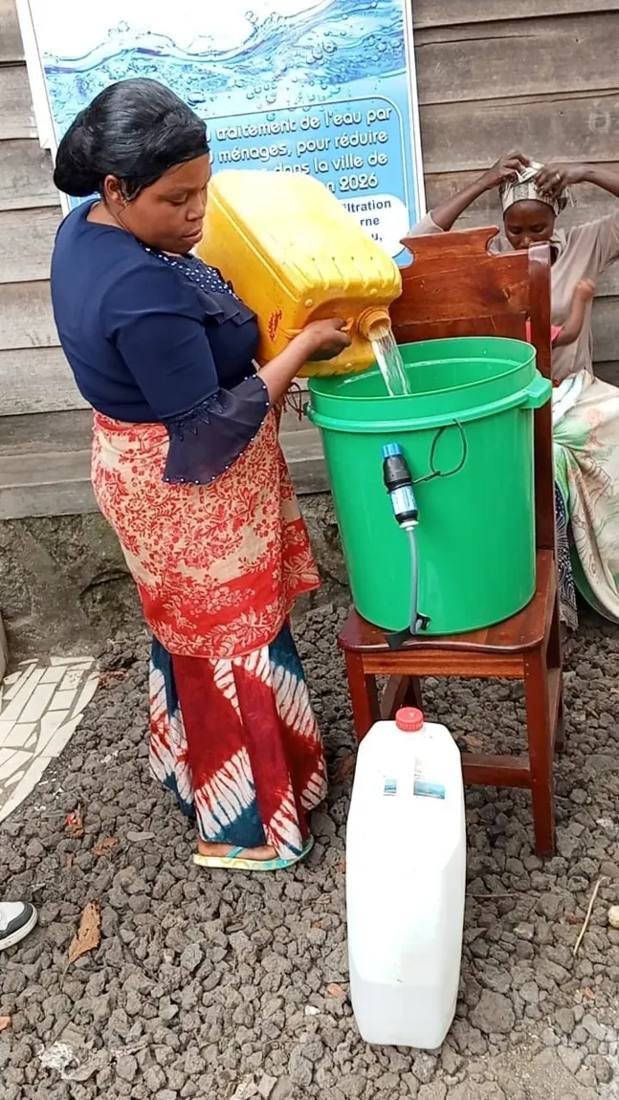
Each system is a Sawyer gravity filter kit fitted to a 20 to 25 liter bucket on a wooden stand, with an outlet tap to a clean container. Water flows by gravity through hollow-fiber membranes with 0.1 micron pores. The pores are small enough to block bacteria (including those that cause cholera and typhoid) and protozoa (such as those that cause amoebic dysentery). Users backwash the membrane with a syringe after about every 20 liters to keep the flow rate up.
Limits. A membrane filter is not a reliable barrier to viruses, it does not remove dissolved chemicals or metals, and very turbid water clogs it faster. Goma’s sources are mostly clear. Where water is muddy, settling it first (or using a natural coagulant such as moringa seed) protects the filter. Water can be re-contaminated after filtering if it is stored in dirty containers, which is why training covers clean storage.
Monitoring
Internet access in parts of North Kivu is unreliable, so PALPER records data on paper using a bilingual field form: households served, how often each filter is backwashed, the water sources used, and any reported waterborne illness. PALPER summarizes each phase in a written report with photos and costs.
Costs
| Item | Amount | Notes |
|---|---|---|
| Gravity membrane filter | about $50 | Bought in Kenya, trucked to Goma |
| Delivery, installation, training and materials | about $30 | Bucket, stand, transport and PALPER’s field work |
| Total per filter, all-in | about $80 | Serves about 25 people (5 households) for about 5 years |
| Cost per person | about $3.20 | About $0.64 per person per year |
| Estimated cost per life saved | about $1,000 | Estimate; method at cleanwaterhelp.org/technical |
| 50 more filters | about $4,000 | Ordered September 2026 |
| Fundraising goal | $20,000 | 200 filters ($16,000), then a used truck, pump, collapsible tank and materials to deliver lake water |
Decisions and the options we set aside
| Decision | Options considered | Why |
|---|---|---|
| Household gravity filters first | Community treatment plant; chlorine tablets; hand-pump UF units | Low cost, no power, no consumables, proven in emergencies, and PALPER can install them within weeks. |
| Share each filter among five households | One filter per household | Spreads the benefit to more people and builds shared ownership; matches filter capacity. |
| No household chlorine for now | Bleach drops in each container | Correct dosing is hard to sustain and overdosing is a risk; the filters already remove the main pathogens. |
| Buy inside Africa and ship by truck | Air freight from China to Kinshasa | The air-freighted units never reached Goma; trucks from Kenya arrived in about four weeks. |
| Deliver water after the filter rollout | Buy a used truck and water bladder now | Filters come first. The $20,000 goal then adds a used truck, pump and tank, planned so delivery does not undercut local water sellers. |
Risks and how we respond
| Risk | Level | Response |
|---|---|---|
| Conflict and insecurity around Goma | High | PALPER leads all field work; CWH sends funds only against documented activity. |
| Shipping disruption (war, Ebola) | Medium | Ship by truck in batches of 10 and pay per shipment. |
| Banks suspended in Kivu | Medium | Transfers through mobile money with receipts for every payment. |
| Filters clog or are not backwashed | Medium | Training, backwash syringes, monitoring visits, simple settling for muddy water. |
| Re-contamination after filtering | Medium | Clean storage containers and hygiene training. |
4 What we learned and what is still open
- Supply chains decide the design. The best filter on paper is useless if it cannot reach Goma. Buying in Kenya and trucking in batches of 10 is slower but reliable.
- Simple wins. A filter that needs no power, chemicals or spare parts was installed and in use within weeks.
- Filters fix quality, not access. Families still walk to collect water. The next phase has to address distance.
- Paper data is fine. Where the internet is cut, a clear paper form collected by a trusted partner works.
Open questions
- How can truck delivery of lake water work without undercutting local water sellers?
- How long do the filters keep full flow under Goma conditions, and how often do families backwash them?
- Can PALPER extend the program to other territories (Rutshuru, Nyiragongo, Masisi) with grant funding?
- Which funders will support filters and a local operator together?
5 How you can help
Put safe water in five more homes
About $80 buys one filter with its bucket, stand, delivery and training, and serves about 25 people for years. 100% of donations to this project go to filters and PALPER’s field costs.
- Give: cleanwaterhelp.org/projects/drc
- Introduce a foundation or company: impact@cleanwaterhelp.org
- Volunteer your expertise: cleanwaterhelp.org/contact
References and sources
- PALPER. Activity reports for the filtration project in Goma, Phase 1 (July 16, 2026) and Phase 2 (August 13, 2026). In French; summarized by CWH.
- PALPER. Program report and WASH evaluation, Rutshuru Territory (2025).
- Clean Water Help. Filter Use Procedure (English and French) and Monitoring & Evaluating Protocols, June 2026.
- Clean Water Help. Water Transport Solutions Comparison, June 2026.
- Sawyer Products. Gravity filter kit specifications (0.1 micron hollow fiber). Manufacturer information.
- Clean Water Help board approvals, July 20, 2026 and September 1, 2026.