The challenge
Laguna de Bay is one of Southeast Asia’s largest inland lakes and feeds millions of people — and like nearby Sampaloc and Lumot lakes, it’s choking on phosphorus. The result is harmful algal blooms and toxic cyanobacteria, and fish kills that wipe out the fish pens families depend on for a living.
Before anyone spends money on a cure, someone has to answer the core question: is the phosphorus coming from today’s watershed runoff, or leaching out of decades of legacy pollution buried in the lakebed? The answer changes everything about the fix.
Our solution
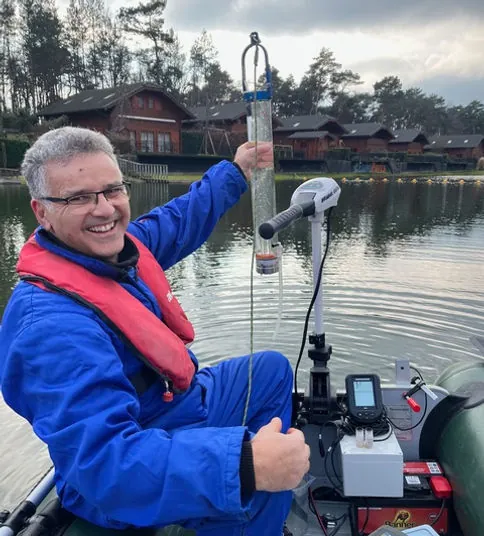
Our largest science team — limnologists, ecologists, and data scientists — is running a pro-bono diagnosis: sediment phosphorus fractionation, water-column nutrient profiling, and satellite remote sensing across all three lakes. July 2023 fieldwork is done, with sediment sampled at roughly two dozen sites (one Sampaloc core ran a striking 2,552 mg of phosphorus per kg).
Where the lakebed turns out to be the source, a relatively cheap aluminum treatment can lock the phosphorus down. It costs the public nothing — it’s our expertise, donated, alongside the LLDA and UP Diliman, where a commercial study would run into the hundreds of thousands.
Who does what
We are force multipliers, not occupiers — the local partner leads and we supply the science, the design, and the funding.
- Build the nutrient mass balance and algae analysis
- Process satellite imagery of the lake
- Translate findings into practical interventions
- Hand a clear roadmap to the authorities
- Provide data and field sampling (LLDA)
- Co-lead the science (UP Diliman)
- Implement recommendations through the authority
The team behind it
Volunteer scientists and engineers donating their expertise to this project — most names link to their work.